Moving to Tennessee? Here’s What Nobody Tells You
So, you’re thinking about moving to Tennessee. You are definitely not alone. Over the last few years, the Volunteer State has become one of the hottest relocation destinations in the United States. Whether you are a remote worker fleeing the high costs of California or New York, a family looking for a safer place to raise kids, or a retiree trying to stretch your hard-earned savings, Tennessee looks incredibly good on paper.
And why wouldn’t it?
But here is the honest truth from a local perspective: moving to a new state is about more than just checking off a list of financial perks. Every state has its quirks, its hidden costs, and its unspoken rules. What is the real cost of living? What do the local “born and raised” residents actually think about all this growth? And is Tennessee really cheaper in the long run?
Before you hire an agent, put a down payment on a piece of land, or book your professional movers, let’s pull back the curtain on what life in Tennessee is actually like: the good, the bad, and the unexpected.
Why Everyone is Moving to Tennessee
The influx of new residents to Tennessee isn’t an accident; it’s a massive demographic shift. People are moving to Tennessee because it offers a rare combination of economic opportunity and a slower, more intentional lifestyle.
For young professionals and remote workers, cities like Nashville, Knoxville, and Chattanooga provide a booming tech and corporate job market without the oppressive pace of the Northeast or West Coast. Families are drawn by excellent suburban school districts in places like Williamson County, while retirees find solace in the mild winters and community-oriented neighborhoods.
There is a distinct sense of freedom and space here. When you cross the state line, the air feels a little clearer, the pace slows down just a hair, and people still look you in the eye and say hello at the grocery store. But adapting to the South takes some transition, especially if you’re used to the hyper-efficient, fast-paced rhythms of a major coastal metropolis.
The Real Financial Breakdown: Cost of Living vs. Hidden Fees
Let’s talk about the number one reason people consider a Tennessee relocation: the cost. If you are moving from Seattle, Chicago, or Miami, the overall cost of living in Tennessee will initially feel like a massive financial relief. But you need to look closer at the math to see if it’s truly cheaper for your specific situation.
State Income Tax and Property Taxes
Let’s start with the headline benefit: Tennessee has no state income tax. You get to keep a significantly higher percentage of your take-home pay. For high earners or remote employees maintaining a coastal salary, this feels like an instant raise.
Additionally, property taxes here are remarkably low compared to the rest of the country. Even in affluent enclaves like Brentwood or Franklin, your annual property tax bill will be a fraction of what you would pay for a similar home in New Jersey or Illinois.
The Sales Tax Sting and the Grocery Tax
Here is what nobody tells you: the state has to make its money somehow. To compensate for the lack of state income tax, Tennessee has some of the highest sales tax rates in the nation.
- The base state sales tax is 7%.
- Local counties and municipalities add their own percentage, usually bringing the total local sales tax up to 9.25% or 9.75%.
Worse yet, Tennessee is one of the few states that still charges a state sales tax on grocery items. While the rate for food is slightly lower than the standard retail tax, your weekly shopping trip for milk, eggs, and produce will cost more at the register than you might expect. When you factor in the rising price of everyday goods, your monthly grocery budget might not shrink as much as you hoped.
The Housing Market, Land, and Real Estate Realities
The Tennessee housing market has experienced explosive growth, transforming the landscape for buyers and renters alike. If you watched a YouTube video from five years ago detailing how cheap it is to buy a home here, we have some news: that market simply doesn’t exist anymore.
Buying a Home: From Suburbs to Acreage
If you are looking to purchase a home in the greater Nashville area, prepare for a competitive environment. Desirable suburbs in Williamson County and Davidson County feature home prices that rival many mid-tier coastal markets.
If your dream is to buy a few acres of land and build a custom homestead, you need to look further outside the major metro rings. While rural land is still available, the price per acre has climbed significantly.
Local Tip on Buying Land: If you purchase rural acreage, always verify the soil “perc test” (percolation test) before closing. Much of Tennessee sits on a massive bed of limestone rock. If the ground cannot support a septic system, or if clearing the land requires blasting through solid rock, your dream home project could face massive, unexpected infrastructure costs before construction even begins.
East Tennessee vs. Middle Tennessee
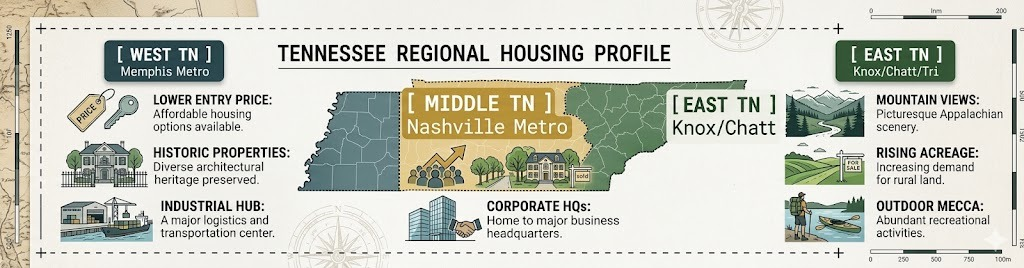
Culturally and geographically, Tennessee is actually three distinct regions (known legally as the “Three Grand Divisions”), but the primary choice for most transplants comes down to East vs. Middle. They offer completely different lifestyles.
Middle Tennessee
Middle Tennessee is characterized by rolling hills, bluegrass pastures, and a booming corporate footprint. It is home to Nashville, the center of the state’s healthcare, music, and tourism industries. Life here is faster, more cosmopolitan, and highly focused on growth and networking. It’s where you move if you want to be near high-profile dining, major corporate headquarters, and a bustling suburban lifestyle.
East Tennessee
East Tennessee is dominated by the majestic Appalachian Mountains, Knoxville (home of the University of Tennessee), and Chattanooga. The landscape here is visually stunning, featuring dramatic ridges, pristine lakes, and deep valleys. The culture is distinctly Appalachian—deeply rooted in outdoor recreation, hiking, fishing, and a quieter, more laid-back pace of life. If you want a home with a mountain view and easy access to nature, East Tennessee is your destination.
Nashville
If you’re drawn to the energy of the state’s capital, it helps to look past the neon signs of lower Broadway to understand the daily reality of living in Nashville.
The Pros:
- World-Class Culture: You have access to an incredible food scene, professional sports (NFL, NHL, MLS), and live music of every genre playing 365 days a year.
- Economic Vitality: The job market is incredibly resilient, backed by massive healthcare networks, tech hubs, and a thriving entrepreneurial business climate.
- Diverse Neighborhoods: From the historic charm of East Nashville to the polished, family-friendly streets of suburban Brentwood, there is a community style for everyone.
The Cons:
- The “Bachelorette” Tourism Factor: Locals rarely go near downtown on weekends unless they are attending a game or concert. The tourist heavy areas can feel loud and congested.
- Rapid Urbanization: Historic homes are frequently torn down to build dense, modern tall-and-skinny duplexes, changing the architectural feel of classic neighborhoods.
- The Cost Premium: Nashville is no longer a hidden gem. Living within a 30-minute commute of the city center requires a premium price tag.
Weather Risks: The Truth About Tennessee Tornados and Humidity
Many transplants move to escape freezing Midwestern winters or brutal Northeastern blizzards. While Tennessee does enjoy a beautifully distinct four-season climate, its weather pattern carries risks that you must take seriously.
The Severe Weather and Tornado Risk
Tennessee does not sit in the traditional “Tornado Alley” of the Great Plains, but it is part of Dixie Alley—a region of the South that experiences highly volatile, severe spring and autumn weather systems.
Unlike Midwestern tornados, which can often be seen across flat miles of farmland, Tennessee tornados frequently form at night, travel fast over rolling hills, and are wrapped in heavy rain.

When you look at a house to purchase, check for a designated safety zone. Does it have a basement? If it’s on a concrete slab, is there a reinforced interior storm room? Having a plan for severe weather risks is an essential part of living here.
The Endless Summer Humidity and Autumn Allergies
Summers in the South are a marathon of thick, heavy humidity. From mid-June through August, step outside and you’ll immediately feel the damp air. This climate also means you will share your environment with plenty of local wildlife—including mosquitoes, ticks, and the infamous “cicadas” and wood-boring bugs.
Additionally, Middle and East Tennessee sit in geographic basins that trap pollen. If you have never suffered from seasonal allergies before, prepare yourself: the local spring and fall pollen counts frequently turn transplants into daily allergy medication users.
Infrastructure, Traffic, and the Reality of the Daily Drive
One of the biggest culture shocks for people moving from states with robust public transportation networks is just how car-dependent Tennessee is. Here, your vehicle is your lifeline, and you will spend a lot of time behind the wheel.
Traffic and Constant Road Construction
Because the population has exploded faster than the state’s infrastructure can naturally keep pace, traffic congestion has become a major daily hurdle. Routes like I-24, I-65, and I-40 around major hubs experience severe gridlock during morning and evening rush hours.
To cope with this growth, the Tennessee Department of Transportation (TDOT) keeps major highways under perpetual construction. You will encounter orange barrels, lane shifts, and sudden delays as a normal part of your daily drive.
Driving Etiquette and Highway Rhythms
Driving in Tennessee has its own distinct rhythm. The legal speed limit on major rural interstates is often 70 MPH, but the actual flow of traffic moves significantly faster.
You will encounter a mix of drivers: aggressive out-of-state transplants accustomed to fast coastal highways, local rural drivers who prefer a relaxed pace, and massive commercial semi-trucks utilizing Tennessee’s logistics corridors. Navigating this mix requires defensive driving habits, patience, and an acceptance that your 15-mile commute might take 45 minutes on a rainy day.
Lifestyle, Culture, and Social Integration
Adjusting to the local lifestyle means understanding the social fabric of the South. Tennessee culture is built around faith, family, football, and food.
Southern Hospitality vs. “Bless Your Heart”
Southern hospitality is real. Neighbors will welcome you with baked goods, strangers will strike up conversations in the checkout line, and people are generally polite and helpful. However, there is a social nuance to learn.
Southern politeness is sometimes a mechanism to maintain pleasant boundaries. If someone tells you, “We should get together sometime!” it’s a friendly gesture, but it’s up to you to make the concrete plans. And if you hear the phrase “Bless your heart,” pay close attention to the context—it can range from genuine sympathy to a polite way of saying you’re completely clueless.
Addressing the Elephant in the Room: Race and Social Dynamics
Transplants often wonder about the social and political climate of the modern South. Tennessee is a deeply conservative “red” state politically, though urban centers like Nashville and Memphis lean progressive.
Regarding race and integration, newcomers from diverse metropolitan areas often find that while major cities are highly cosmopolitan and multicultural, rural areas can still feel very traditional. Open, honest conversations with a local relocation expert or spending a week exploring your target neighborhoods firsthand can help you find a community that feels safe, aligned, and welcoming to your family’s lifestyle.
What the “Born and Raised” Locals Think About the Growth
You cannot talk about moving to Tennessee without addressing the perspective of the people who have lived here for generations. The rapid pace of growth has created a bittersweet dynamic for native Tennesseans.
On one hand, the influx of capital, new businesses, and upscale dining options has boosted the local economy and raised property values for longtime homeowners. On the other hand, many born-and-raised residents feel priced out of their own hometowns.
Small farms that defined rural counties for a century are regularly sold off to developers to build master-planned subdivisions. Locals miss the days when traffic didn’t exist and a modest middle-class income could easily secure a home with a large yard.
As a newcomer, the best way to earn the respect of your new neighbors is simple: Humility.
Avoid comparing your new home to where you came from. No one wants to hear, “Well, back in New York we did it this way,” or “In California, the food was much better.” Embrace Tennessee for what it is, support local businesses, and show appreciation for the culture that made you want to move here in the first place.
Is Tennessee Actually Cheaper Long-Term?
Will relocating to Tennessee actually save you money over the next ten to fifteen years?
The answer depends entirely on your lifestyle and where you choose to live. If you are relocating from an expensive state, cash out your home equity, buy a house in Tennessee outright with no mortgage. The idea here is to work remotely; you will come out significantly ahead. The lack of state income tax will feel like pure profit.
However, if you are moving to Tennessee relying on a local employer’s pay scale, remember that local wages often reflect the historically lower cost of living. While jobs are plentiful, the average local pay rate may be lower than what you are accustomed to on the coasts. When you combine local wages with high sales taxes, rising home prices, and premium costs for everyday goods and services, the financial advantage can shrink quickly.
Tennessee is a phenomenal place to build a life, but it is no longer a “budget-basement” state. It is a premium destination that commands real value.
Frequently Asked Questions About Moving to Tennessee
To assist with your relocation planning, here are quick, direct answers to the most common questions people ask before moving to the Volunteer State:
Does Tennessee have an annual vehicle inspection?
No. Tennessee eliminated its mandatory annual vehicle emissions testing for most counties. You do not need to take your car to a state inspection facility to renew your registration tags each year.
How bad are the winters in Tennessee?
Winters are generally mild compared to the Midwest or Northeast, but the state does get occasional snow and ice storms, particularly in January and February. Because the state doesn’t maintain a massive fleet of snowplows, even an inch of snow or a light layer of ice can shut down local schools, roads, and businesses for a few days.
What are the hidden costs of building a home on rural land?
The primary hidden costs involve infrastructure. Bringing electricity lines to a remote lot, drilling a water well, clearing thick trees, blasting through subsurface limestone bedrock, and installing a permitted septic system can easily add tens of thousands of dollars to your initial budget before the actual foundation of the home is poured.
What is the state’s approach to school choice?
Tennessee offers a robust mix of educational environments. Alongside traditional public schools in high-performing districts like Williamson County, there is a strong presence of private schools, public charter schools, and an active, legally protected homeschooling community.
How to Prepare for Your Tennessee Move
Relocating across state lines is a massive logistical and emotional undertaking. The secret to a successful move is avoiding assumptions. Don’t assume the buying process is the same, don’t assume the weather is always sunny, and don’t assume you can handle the logistics all on your own. You can reach out to our team for help with moving.
Take the time to visit the state during different seasons. Drive the local highways during actual rush hour, walk the aisles of the local grocery store, and talk face-to-face with people who live in the neighborhoods you are considering.
When you’re ready to make the transition, partner with local experts who understand the terrain. From an experienced local real estate agent who knows which soils perc, to professional movers who know how to safely navigate narrow, winding rural roads, having the right team makes all the difference. Treat your move not just as a change of address, but as a long-term investment in a new community and Tennessee will welcome you with open arms.